Why AI Projects Fail: It Is Not About the Technology
TL;DR
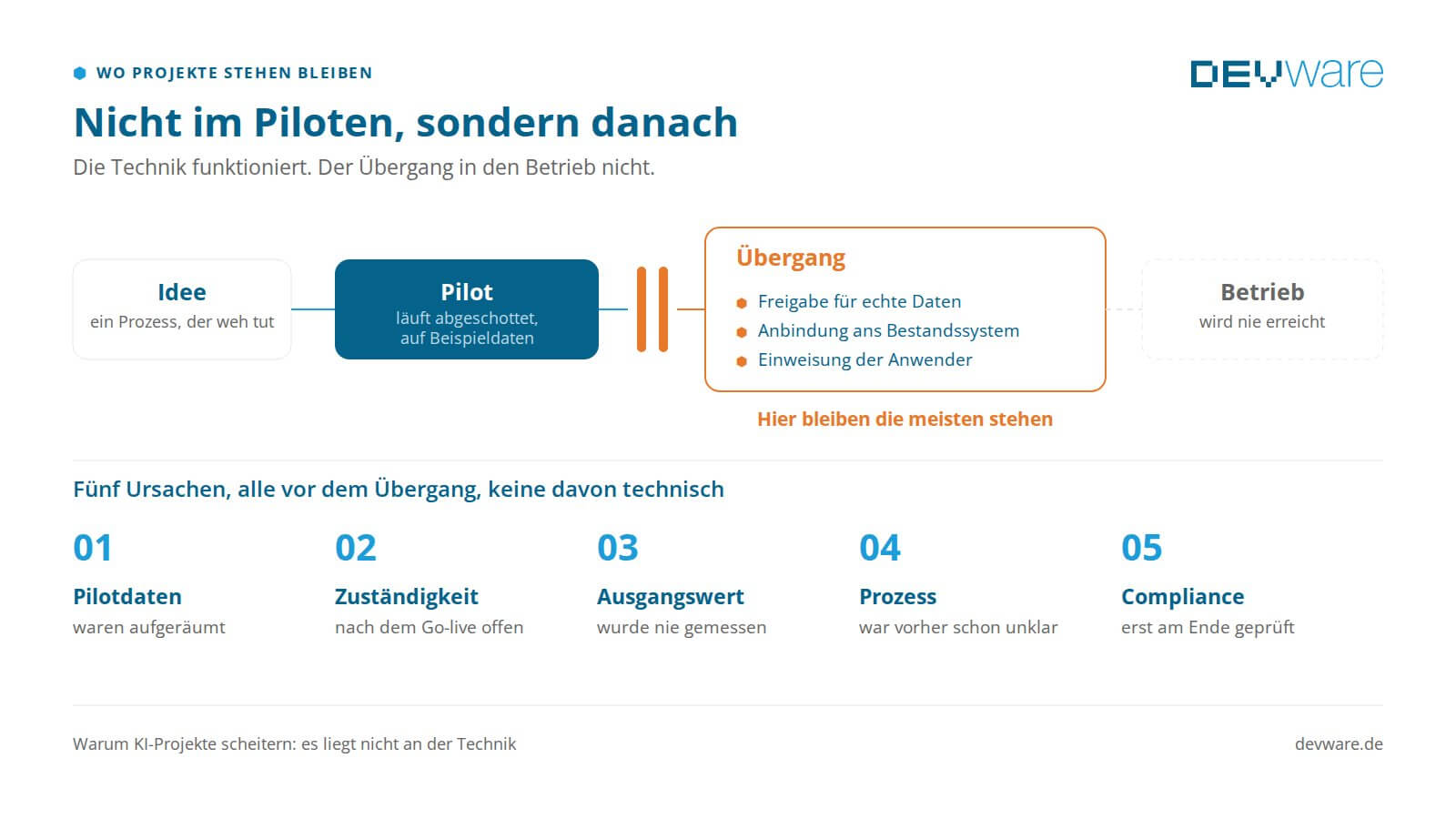
What matters less is how many AI projects fail, and more where they get stuck, and that is almost always the same point: the move from pilot to production. That is where everything comes together that nobody needed during the pilot: approval for real data, integration with existing systems, and training the people who will use it. Five causes explain most of the failed projects, and none of them is technical.
When an AI project fails, it is almost never because of the model.
It is because the pilot ran on cleaned-up data and production does not. Because nobody was named to take responsibility for the results. Because nobody defined in advance what success would look like. Because the process the AI was supposed to improve was not working well to begin with. And because data protection and security were only checked once the system was already built.
These are five organizational points. The technology is not on this list.
This article first describes what actually lies between a working pilot and production, then goes through the five causes, each with the early warning sign to watch for, and ends with the questions we ask before starting any AI project.
What Stands Between Pilot and Production
A pilot almost always starts at the edge of the organization. A small group tries something out, on its own access, with sample data, without any connection to the systems where the work normally happens. That is the right way to quickly see whether an idea holds up.
But that very isolation is exactly why the next step is so hard. Between a pilot that convinces people and a production system that people can rely on lie three things nobody needed during the pilot.
Approval for real data. In production, customer and personal data flow through the system. That turns data processing agreements, roles and permissions, logging, and deletion periods into prerequisites rather than formalities. If this was not considered during the pilot, the project stalls right here, even though the technology has long been working.
Integration with the existing system. A pilot runs on uploaded files. Production has to happen where the work already lives: in the ERP, in document management, in the ticketing system, in the line-of-business application. That means interfaces, permissions, error handling, and operations that need to be monitored. This part is the most demanding in the whole project and the most often underestimated. It is also the point where most companies bring in a partner, because it no longer has anything to do with experimenting.
The people who are meant to use it. Production assumes that the department knows what the system does, what it does not do, and how to recognize an incorrect result. Without this training, you get either blind trust or quiet rejection. Both destroy the benefit.
Anyone who only starts on these three points after the pilot loses months. Anyone who already knows them when scoping the pilot builds it differently.
Cause 1: The Pilot Ran on Data That Does Not Exist in Production
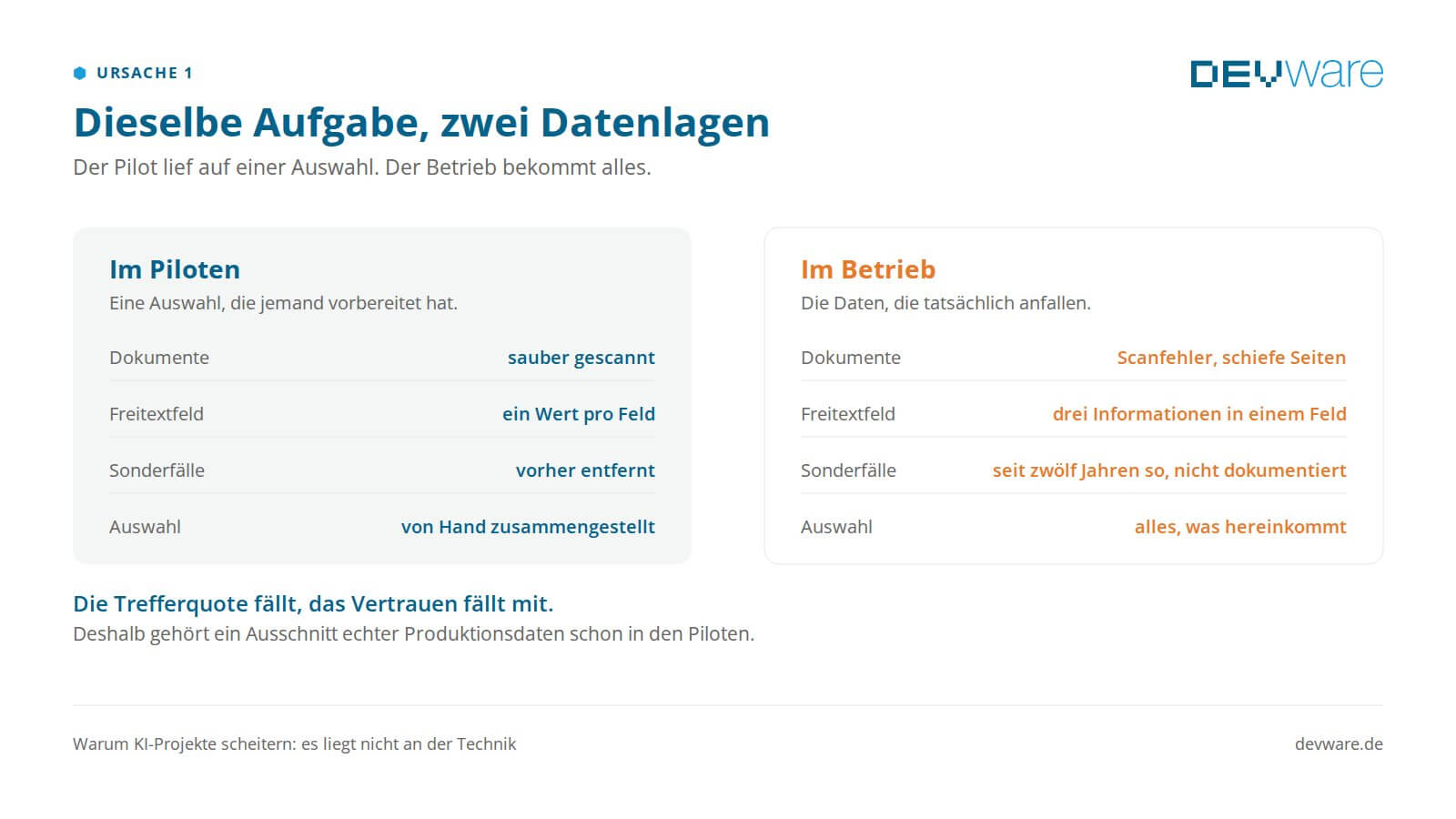
A dataset gets put together for a pilot. Someone from the department picks out examples, cleans them up, removes the outliers. The result is convincing, the accuracy looks right, everyone is happy.
Then the real data arrives in production. Documents with scanning errors, free-text fields where someone crammed in three pieces of information, edge cases that have been handled the same way for twelve years and were never written down anywhere. Accuracy drops, trust drops with it, and after a few weeks nobody uses it anymore.
How to spot it early: Ask who put together the dataset for the pilot and how long it took. If the answer is two days, a colleague did it, you are not testing your data, you are testing a selection of it.
What helps instead: Run the pilot on a slice of real production data, including the cases nobody likes. A lower, honest accuracy figure in the pilot beats the reverse.
Cause 2: Nobody Is Responsible for the Result
An AI system makes suggestions, not decisions. Someone has to review those suggestions, approve or correct them, and someone has to answer for it if something wrong slips through.
In many pilots, that is the project lead, simply because they are already there. In production, the project lead is gone. If nobody has been assigned to take over that role, one of two things happens: either nobody checks, and the first visible wrong result ends the project, or everyone double-checks everything, and the time savings that justified the whole thing in the first place disappear.
How to spot it early: Ask who will check the output after go-live, by name. If the answer is a department rather than a person, the role has not been filled.
What helps instead: Review belongs in the interface, not in a side task. A human reviews it is quickly written into a concept document. In the software itself, there needs to be a place where that person sees what the system suggests and can change it without leaving the workflow. Without that place, review turns into rubber-stamping.
Training is part of this. Whoever reviews the output needs to know how the system arrives at its suggestion and in which cases it typically gets it wrong. An hour at the start and a fixed contact person for follow-up questions are usually enough. Without both, review becomes a formality.
Cause 3: Success Was Never Defined Before Starting
This cause is the most common one, and the easiest to avoid.
A pilot starts with the goal of seeing what is possible. Three months later, there is a system that clearly can do something. Then someone from management asks what it actually delivered, and nobody has a number. There is no number because nobody measured beforehand how long the process took without the system.
Without a baseline there is no comparison. Without a comparison there is no approval for the rollout. The project does not fail because of bad results, it fails because it cannot show any results at all.
This is not a fringe issue: in the GenAI Impact Report Germany 2026 by adesso, 17 percent of companies say they do not measure the return on investment of their AI use at all.
How to spot it early: Before starting, ask which number is supposed to improve and what it currently stands at. If the second half of that question goes unanswered, the pilot is not ready to start.
What helps instead: Measure for a week before building anything. How many cases per day, how long per case, what the current error rate is. It is unglamorous work, and it later decides whether the project continues.
Cause 4: The Underlying Process Does Not Work
The most uncomfortable point, and the reason we regularly advise clients against AI.
AI speeds up a workflow. It does not organize it. If a process has unclear responsibilities, if the same information is maintained in three places, if there is an exception for every second case, an AI system makes that process faster and more confusing at the same time. The result ends up worse than before, even though the technology works.
In these cases, the right answer is not a better model, it is clarifying the process or building an interface that stops the same information from existing three times over. That is less exciting than an AI project, and it actually solves the problem.
How to spot it early: Have two people who do the process daily describe it to you. If the descriptions differ, there is no process, only a habit.
What helps instead: Clarify the process until two people describe it the same way. Only then can you seriously judge whether AI adds anything there. Not before.
Cause 5: Compliance Was Only Checked at the End
Nobody asks about data protection during the pilot, because it runs on test data. When the project moves to production, the question suddenly arrives in full, and from several directions at once: the data protection team wants to know which data flows where. IT security wants to see roles and logs. Management wants to know who is accountable if a result is wrong.
If this only starts now, the outcome is rarely an outright no. More often it is months in which a finished system sits there and nobody is willing to sign off on it. Those months cost the project its support within the company, and once that support is gone, so is the project.
How to spot it early: Ask who represents data protection in the project and when they were first consulted. If the answer is, we will do that when the time comes, the go-live date only exists on paper.
What helps instead: Bring data protection and IT security to the table when scoping the pilot, not at sign-off. It usually comes down to a few decisions: which data the system may see, where it is processed, who has access, and how long it is retained. Settled early, these are simply parameters. Settled late, they become roadblocks. What evidence you can ask a software provider for is covered under Compliance Evidence from a Software Provider.
What Is Not a Cause
Three things that regularly get blamed and are rarely the real cause.
The wrong model. Choosing the model has become one of the easier decisions in the project these days, and it can be changed later. It almost never decides success or failure.
Too little budget. The model is the cheapest part of the bill. The effort lies in connecting to existing systems, in permissions, and in making the data accessible in the first place. Anyone who saves on the model and underestimates this part has the ratio backwards. Respondents in the GenAI Impact Report Germany 2026 see it the same way: only 21 percent name budget as a hurdle, well behind the organizational reasons.
The missing AI strategy. What does not help you is an outside consultant who hands over a generic AI strategy as a slide deck and then disappears. What does help you is a strategy document that describes where AI fits into your existing software landscape, and a concrete placement of your specific project: not a statement of intent, but a decision about which system will take on which task going forward. What that looks like is covered in the next section.
Why Preparation Makes the Project Faster
A pilot is supposed to be fast, and that is correct. But fast does not mean starting without a plan.
For a single use case, you can almost always find a tool that covers exactly that case. That works fine as long as it stays at one case. Once a second one comes along, the same data suddenly sits in two places, permissions differ, and instead of one data protection review there are now two. After the third tool, the company is managing a patchwork of isolated solutions instead of software.
That is why, for us, an AI project does not start with the pilot, it starts with placing it within the existing software landscape: which systems are in use, which still hold up, which are being replaced, and where extending makes more sense than replacing. Only after that is it clear where an AI feature can reasonably plug in, which data it may see, and whether today's decision will still hold up in ten years.
This matches what we see in practice: in the GenAI Impact Report Germany 2026, 43 percent of IT decision-makers name missing integration options for AI as one of the biggest drivers of modernization, and 46 percent expect modernization to mainly deliver better conditions for using AI.
This groundwork settles four things:
- Which applications stay, which are replaced, and which are extended.
- Where the data that is needed lives, and who may access it.
- What data protection and IT security framework applies, before anything is built.
- What scope produces something usable within six weeks.
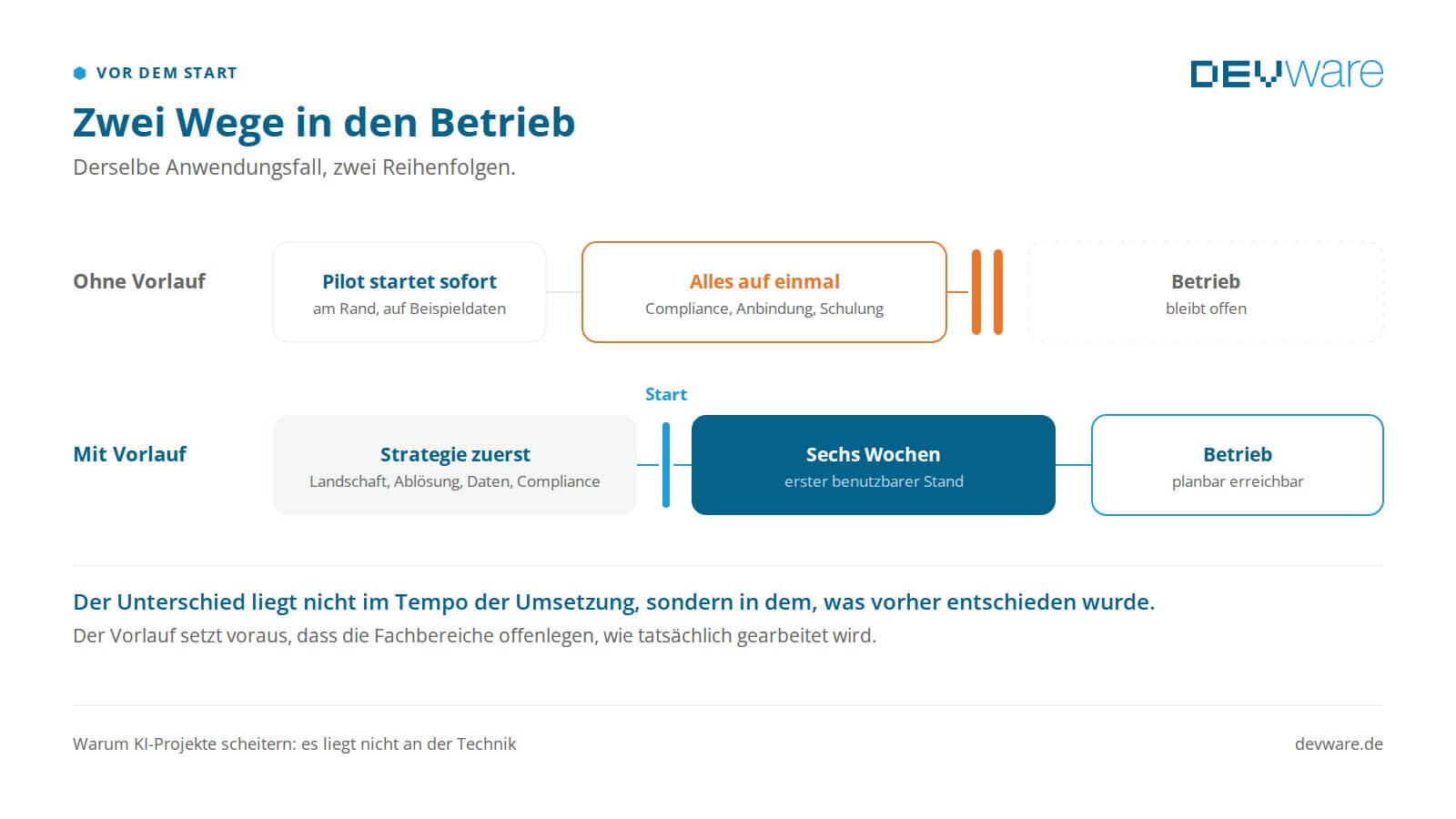
From this point on, things move fast. Once these questions are answered, the rest is execution. AI agents write code very quickly these days, interfaces take shape as a prototype within days, and a first usable version after six weeks is realistic. What cannot be sped up is the decision about what to build.
What we need for this. This groundwork only works together with the business departments. We need insight into how work actually happens internally, which systems are in use, and where the real workflow deviates from the official description. Without that insight, what you get is not a strategy but a guess. Six weeks is therefore not a promise for every project, it is what becomes possible once the decisions have already been made.
The Six-Week Rule
A rule from practice that has proven to be a useful filter: if there is nothing usable after six weeks, the scope was wrong.
The six weeks do not start at the first conversation. They start once the groundwork is complete: requirements are set, the scope is decided, data access is clarified. From that point on, the clock is meaningful; before that, it measures nothing.
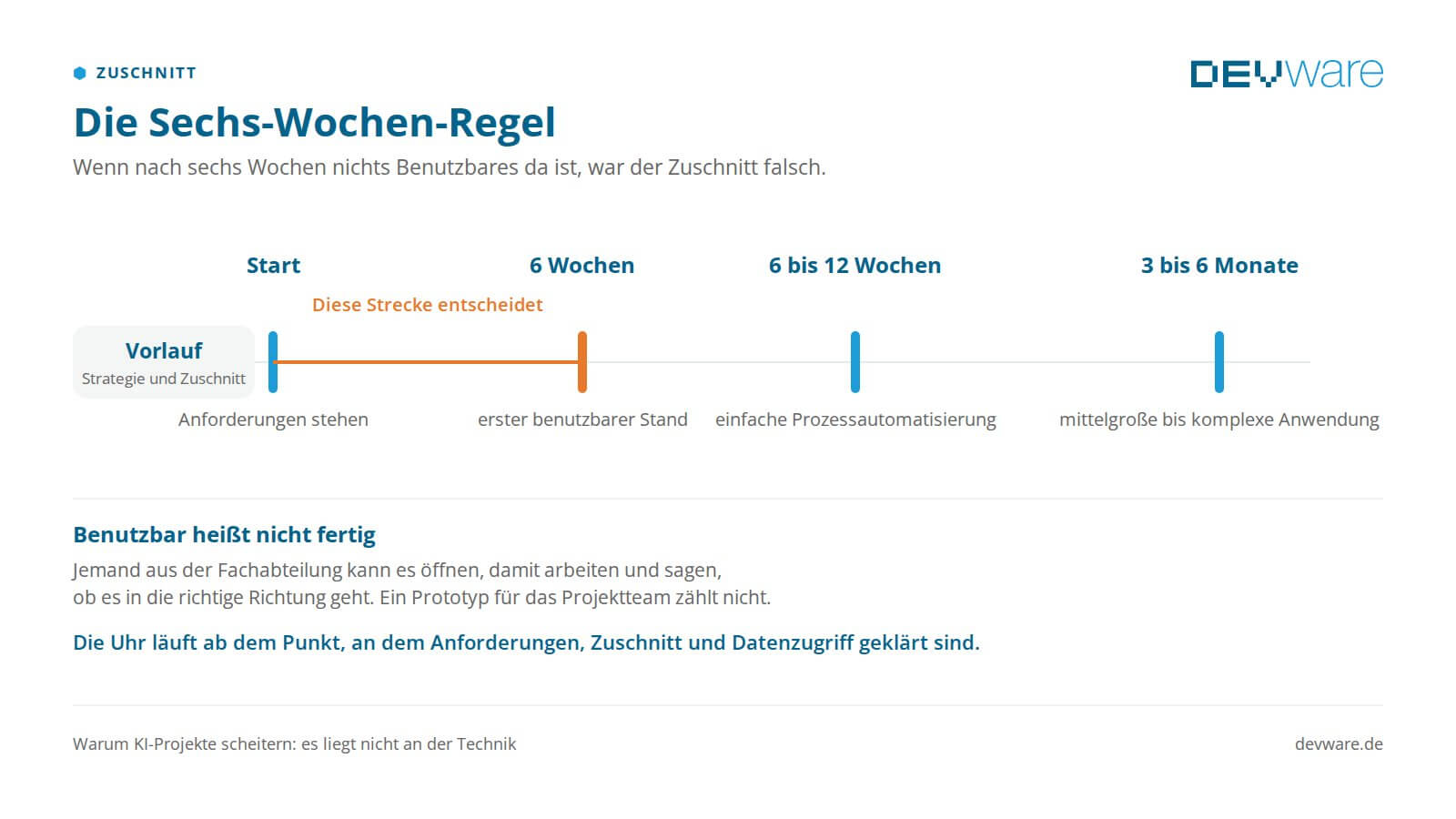
Usable does not mean finished. It means someone from the department can open it, work with it, and say whether it is heading in the right direction. A prototype that only the project team can operate does not count.
The rule helps less with building than with scoping. A project that produces nothing usable within six weeks is usually scoped too broadly and can be split up. Six to twelve weeks is a realistic timeframe for a first productive version or a simple process automation; medium to complex applications tend to take about three to six months.
Frequently Asked Questions
How many AI projects fail?
The figures vary depending on the study and on what counts as failure. What matters more is the reason. In the GenAI Impact Report Germany 2026 by adesso, 38 percent of respondents name compliance and security as the biggest hurdle for AI in software development, 34 percent name missing skills in the team, and 25 percent name lack of acceptance. Outdated architecture (20 percent) and lack of data access (15 percent) follow behind that. So the key point is not the percentage, but that most projects do not fail because of the technology, they fail at the transition from pilot to production.
What do AI projects fail at most often?
At five points: the pilot ran on cleaned-up data that does not exist in production. After go-live, nobody is named as responsible for the results. No baseline was measured to prove the benefit. The underlying process was not clear enough to begin with. And data protection and IT security were only checked once the system already existed.
Why does our pilot not make it into production?
Usually because production requires three things nobody needed during the pilot: approval for real data, integration with the systems where the work happens, and training for the people who will work with the results. All three can be prepared while the pilot is still running.
What does an AI project cost?
Running the model is usually the smallest line item. The real effort lies in connecting to existing systems, in permissions and data access, and in the interface people use to review the results.
When is AI the wrong answer?
When the underlying process is not clear, when the data needed is not accessible, or when a simple rule would achieve the same result. In these cases, we advise against it. An interface or a clearer process is then the cheaper and more durable solution.
Do we need to replace our software to use AI?
Usually not. AI is connected to existing applications, right where the work already happens. Building something new only makes sense if the existing system has no interfaces and cannot be given any.
How long does it take for an AI project to reach production?
Counting from the point where requirements and scope are set: six to twelve weeks for a first productive version or a simple process automation, roughly three to six months for medium to complex applications. Before that comes the groundwork phase, in which the project gets placed within the existing software landscape. How long that takes depends on how quickly the business departments provide insight.
What We Clarify Before Starting
Five questions we ask at the start of every AI project. They cost one conversation and can save you a whole pilot.
Which process is meant to improve, and how good is it today?
Without a baseline, there is no way to prove anything later.
What data does the system need to see?
This single question shapes the architecture more than any other. What legal basis is required and which four technical approaches can reduce the risk are covered under Putting Customer Data Into AI Systems.
Who reviews the output after go-live?
By name, not as a department, and at a fixed place within the interface.
What is the smallest scope that is usable within six weeks?
If there is none, the project gets split before anything is built.
Who approves the move to production, and what does that person need for it?
Data protection and IT security belong in the first conversation, not in the final sign-off.
Devware has been developing software for mid-sized companies since 2004 and integrates AI into existing applications, certified to ISO 27001 and ISO 9001. You can find our process under AI Integration, and how we handle customer data under AI and Compliance. What evidence you can ask a provider for is covered under Compliance Evidence from a Software Provider.
Note: This article is a professional perspective from a software developer's point of view, not legal advice.
On how this was written: Our content is created with the support of AI, but every text goes through a double human review before it is published.
Sources
- GenAI Impact Report Germany 2026, focus on software development, adesso SE.
- Application Modernization Survey 2026, adesso SE, cited in the GenAI Impact Report Germany 2026.
- Regulation (EU) 2016/679, General Data Protection Regulation (GDPR), in particular Articles 28 and 32.
- DIN EN ISO/IEC 27001:2024, Information Security Management Systems.