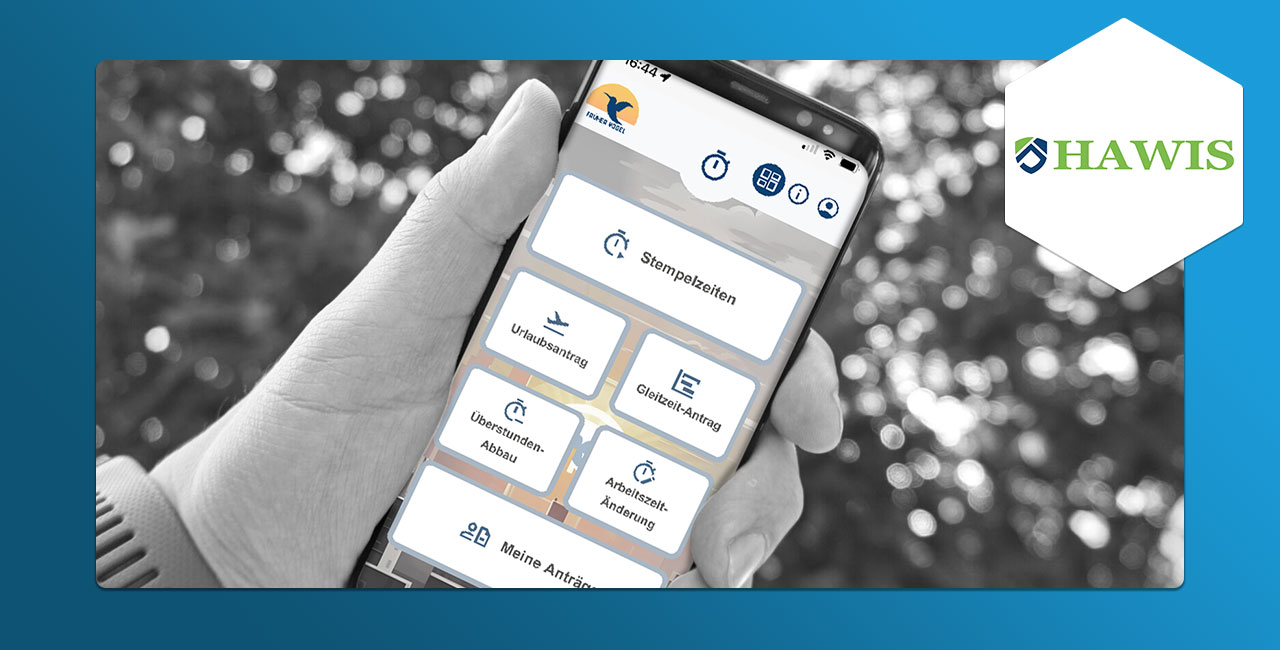
For HAWIS Handwerkswirtschaftsgesellschaft mbH, DEVWARE developed a multi-client-capable time tracking app based on .NET MAUI and Blazor. The solution includes a web admin interface, a native employee app with offline functionality, role-based permission management, and Azure hosting. The goal was a legally compliant, scalable, and intuitively usable time tracking system for trade businesses.
For HAWIS Time Tracking, HAWIS, Handwerkswirtschaftsgesellschaft mbH needed a custom .NET MAUI multi-clienapp, developed under a contract for work. The application launched with development phase 1.0 and was rolled out to the relevant institutions and companies. Each institution (trade association) connects companies whose members can then carry out time tracking. Due to legal requirements, the application is designed to help small businesses properly comply with the regulations set by the Ministry of Labour.

The time tracking app has since proven to be an indispensable tool for small and mid-sized companies. It enables precise, efficient management of working hours, leading to significant time savings and better compliance with legal requirements. The app's user-friendly design lets employees log their hours quickly and easily, while integration with existing systems reduces the administrative workload.
The application was designed to give customers more than just the ability to log working hours and breaks, it also needed to include the following features:
Another requirement was that the application be built as a permission-based, multi-client-capable system. As the product owner, HAWIS has full access to all institutions, while each institution can only access its assigned companies. Depending on their permissions, employees at each company can only view and use certain functions.

The requirements regarding functionality and processes were clarified across several meetings. Based on an initial concept with a fixed-price proposal presented to the customer HAWIS, detailed coordination and refinement followed.
At the start of the project, a test environment was set up on Microsoft Azure along with a testable app version via TestFlight. This let HAWIS employees track project progress in real time. Microsoft DevOps was used as the project management and source code management tool.
The project structure was built in a modular way, allowing future modules to be flexibly adapted. An administrative web application forms the backend, covering login, account, and master data management within the multi-client architecture.
In parallel, an app was developed for employees at each company, enabling time tracking on small devices. The app was built as a .NET MAUI solution with Blazor. Blazor is a framework that allows client-side C# code to be written and rendered in the browser. Razor Pages provide the interface using HTML and CSS. Blazor is a framework for building interactive client-side web applications with .NET.
To allow the apps to be published natively in the app stores, the Blazor app was wrapped in .NET MAUI. This preserves a shared codebase, which simplifies support and future enhancements.
Data is loaded from the server via a web API and displayed in the app. The application is connected to a database that manages all relevant information (e.g. user login, actions, working hours). The app is also offline-capable, so working hours, vacation requests, and other functions can be recorded even without an internet connection.
During the testing phase, manual and automated test procedures were carried out to ensure an error-free handover. User documentation was also created to clearly explain the requirements and their implementation to the customer.
HAWIS employees regularly tested the new web application and the native app across different server environments and were able to actively contribute to development. After all project phases were completed, the application was successfully put into operation.
"During the implementation phase, requests that hadn't even been agreed upon were still taken on board and delivered. That's why we continue to rely on Devware as we expand our digital time tracking."
𝐌𝐚𝐫𝐤𝐮𝐬 𝐍𝐚𝐜𝐤𝐞 - Hawis
The web application and the mobile time tracking app went live on March 1, 2024. The product has already been rolled out to several institutions and their companies. Due to high demand, the second development phase is already underway, adding further features such as overtime rules, QR code scanning processes, and additional types of absence.
Rolling out the time tracking app has significantly simplified day-to-day operations for many trade businesses. With its intuitive interface and comprehensive features, companies can manage working hours more efficiently. The app not only delivers precise time tracking, but also integrates seamlessly with existing systems, greatly simplifying administration.
Planning a similar project? Learn more about our custom software development.